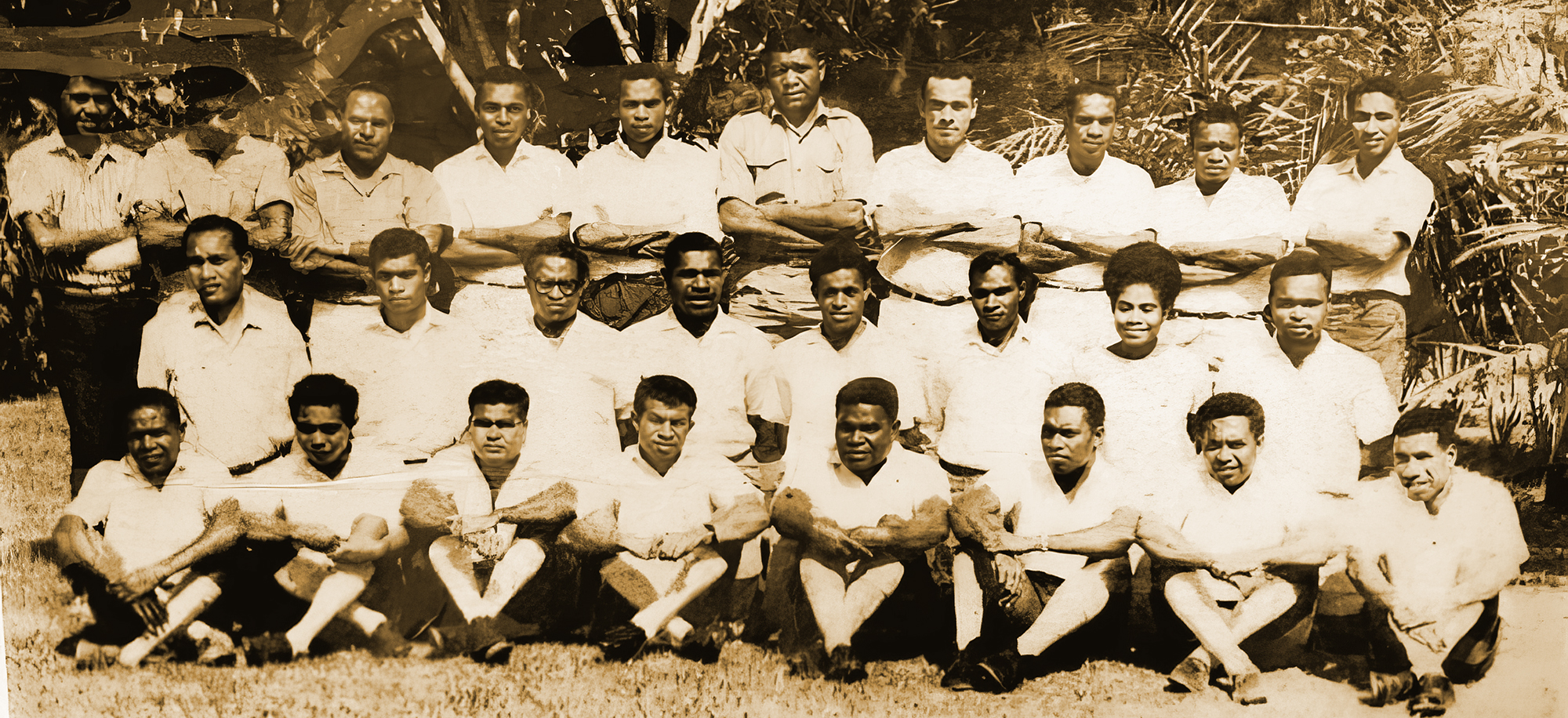
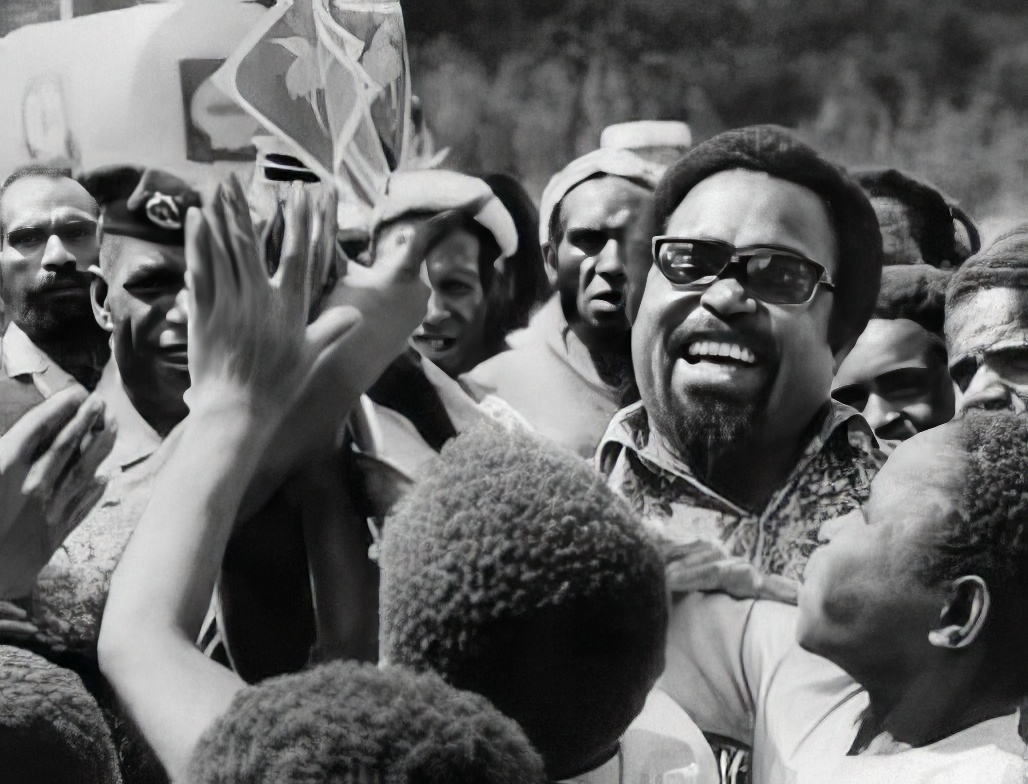
“Grand Chief Sir Michael Somare celebrates Papua New Guinea’s independence with supporters and fellow leaders. The image captures the spirit of unity and pride that defined the nation’s founding generation, symbolising the fulfilment of the hopes first voiced by the Bully Beef Club in the 1960s.”
For those who lived it, the Bully Beef Club was unforgettable. Michael Somare often traced his political career back to those student nights:
“We talked politics and we talked about how countries would be governed … and that made me take interest in politics.” — Michael Somare
As Papua New Guinea approaches its 50th anniversary of independence, The National published a compelling piece—"Tribute to PNG’s Pioneer Parties"—that reflects on how the Bully Beef Club evolved into the Pangu Pati, the nation’s first political party. The article highlights how colonial-era student solidarity, racial inequality, and the leadership of figures like Somare, Kiki, and Nombri transformed informal gatherings into formal political movements. It offers both historical context and a contemporary reflection on how those early conversations laid the foundations for PNG’s party system and pluralistic democracy.
Stephen Pokawin on the Excitement of Independence and the Eight Point Plan
Source: Image and audio courtesy of PNG Speaks and the Papua New Guinea National Museum and Art Gallery.
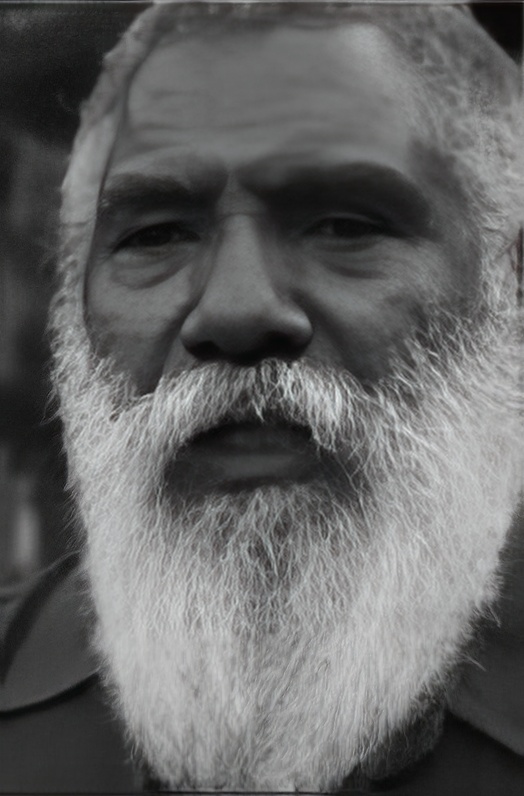
Description
Stephen Pokawin is a Papua New Guinean political scientist and senior lecturer who transitioned from student activism at the University of Papua New Guinea in the early 1970s to provincial leadership and national party executive roles, helping shape PNG’s post-independence governance.
Pokawin recalls how the early 1970s transformed his academic path and political engagement. Initially focused on English and anthropology, he was drawn into politics by the momentum of the 1972 elections, the achievement of self-government in 1973, and the rising influence of the Pangu Party. A pivotal moment came when Michael Somare, then Chief Minister, addressed a packed lecture theatre at the University of Papua New Guinea and introduced the Eight Point Plan. For Pokawin and many of his peers, this speech sparked a surge of adrenaline and conviction, igniting their commitment to independence and nation-building. He situates this awakening within a broader global context, where African independence movements, Gandhi, and Martin Luther King Jr. provided intellectual and moral inspiration. The Waigani seminars, with their open debates and fearless academics, added further urgency to the sense that Papua New Guinea’s future was both imminent and theirs to shape.
Stephen Pokawin
…in that kind of environment. And coming out to Port Moresby was something absolutely new. Yeah. Yeah, but going back to independence, what really got me involved was the period soon after 1972 when Pangu Parti became the choice. Became the choice, and with Pangu Parti comes independence. With United Party comes delayed independence. And it was, in fact, that was what got me into politics. That was what got me into politics, even though after pre-A in 1970, '71, '72, I was more interested in the study of English, and anthropology, anthropology and English.
But then came 72 elections, came self-government in 73, the hypos there that it really got most of us involved. And that's what led me to studying politics. I revisited my grades and it was not that good compared to my English and my anthropology grades. I asked myself, why is it? that I decided to do politics and administration instead of continuing with English and anthropology. But I think the reason basically was the excitement, the excitement of that period.
I can remember in 19, I think, in 1973 or late '72, Mr. Somare, as the chief minister then, came to the university. And at that time, also, we had academics who were free. They were not hindered by anything. They were free to express themselves. They were free to engage in dialogue. Some of them were even free to involve themselves in politics, I think, in court. And Somare came in. He came in and spoke one evening at the main lecture theatre. It was packed. It was packed to capacity. The seats were taken, the corridors were taken, the steps were taken. It was really, really packed. And that was when he introduced the eight-point plan. And I can't remember, I can't remember, that just ignited the adrenaline in almost all of us and sent us almost everywhere in any way that whoever wants to send us to in terms of so-called awareness, self-government awareness, independence awareness, and so on. And that's it. And for me, politics became the subject that I was keen on.
Jonathan Ritchie
Were you conscious of what was happening elsewhere around the world, like in Africa? What were some of the drivers that made you also?
Stephen Pokawin
I mean, in literature, for example, we read African novels. In politics, We learned about [Julius]Nyerere, we learned about Mao Tse-tung, we learned about Gandhi, we learned about Martin Luther King. You know, it was an exciting, exciting period. Yeah, and we even had exciting intellectuals and jurists The Waigani seminar was the thing of the time, you know, it brings the world into Port Moresby. And we had exciting people. And we had Caribbeans, we had Africans. So the atmosphere was charged, I think, basically.
From Barracks to Nationhood: A Reflection by Major General Peter Ilau
Major General Peter Ilau reflects on growing up during Papua New Guinea’s transition to independence and how the Bully Beef Club’s spirit shaped national resilience and leadership.
“I grew up in Taurama and Murray Barracks in the 1960s where politics felt far from our military family life, yet I witnessed the tightly controlled but orderly transition from Self-Government to Independence under the shadow of racial discrimination. I later came to know of the Bully Beef Club more personally through my wife’s father, Penuel Anakapu, a magistrate and early Scout leader who inspired youth leadership and helped shape that circle of nationalists. The Club was part of a much wider awakening—the Mataungan Association, Papua Besena, Bougainville secessionism, and even cargo cult movements tempered by early Christian missions—all reflecting a restless search for justice and identity. From PNG’s extraordinary diversity in language, culture, and geography came the resilience that the Bully Beef Club and PANGU Party drew upon to build strong political institutions. That same spirit, though unevenly applied to the Defence Force and Constabulary, remains the foundation of our nation’s survival and hope, even as governance has weakened in the decades since Independence.”
- October 2025
Reflections on Independence: Ian Macphee on Leadership and Transition
Ian Macphee reflects on witnessing the student movements led by Ebia Olewale and meeting future leaders like Somare and Kiki during Papua New Guinea’s path to independence.
“While pay decisions were understandable in the context of Independence when the PNG economy would have to fund public service wages and administrative costs there was minimal explanation of this and no forecast of when it would occur. It was in this context of wage reduction that Ebia Olewale led the student demonstration in the long march from the college to the administrative centre. I joined the march to explore the concerns of the students and formed a deep friendship with Ebia which lasted until he died and I had the privilege of paying a tribute to him at his funeral. I also met Michael Somare, Julius Chan and Albert Māori Kiki who soon became prominent members of the Parliament that was soon established. Each of them had a realistic view of the fact that it would take many years for them to form a government with knowledge of the economy and how to provide training for vital services such as administration in a range of programs, especially health and education. Menzies had the correct idea that self government should be granted at least a generation before Independence because the administration could only be established effectively and honestly if a second generation arose before the first retired. But Whitlam focused on the cost that this was to an Australian economy that required more domestic expenditure. He granted Independence prematurely and inexperience and corruption followed. ”
- October 2025
Lahui Ako on Unity and Vision
Educator and former diplomat Lahui Ako reflects on the Bully Beef Club as a meeting place for young Papua New Guineans who dared to imagine a different future. Their unity across provinces and spirited debates, he recalls, helped shape the ideas and purpose that guided the nation’s early leaders.
"Its young members, from different parts of PNG, united through a shared vision of progress to exchange bold ideas and challenge conventional thinking. Their spirited discussions stimulated a sense of purpose, laying the groundwork for eventual nation-building"
- October 2025
Dame Meg Taylor on Unity and the Bully Beef Circle
Dame Meg Taylor, former Secretary-General of the Pacific Islands Forum and one of Papua New Guinea’s most distinguished public servants, offers a rare insider’s reflection on the influence of the Bully Beef Club during the years of self-government and early independence. Speaking from her time as a young staff member to Chief Minister Michael Somare, she recalls how the Club’s guiding idea — the unification of Papua and New Guinea — shaped the political foundations of the new nation.
“The key aspect that was discussed often was the unity of Papua and New Guinea. The political constructs were different and bringing both together was vital for the independence of the country as a whole. This came from the Bully Beef Club.”
- October 2025
Her reflections emphasise how Somare drew on a trusted inner circle of colleagues — including Albert Māori Kiki, Tony Voutas, and Cecil Abel — whose early relationships within and around the Bully Beef Club provided both moral counsel and political coherence as he worked to bring the two territories together under one flag.
Keimelo Gima Reflects
Bully Beef Club was made up by young national radicals of the time led by Michael Somare, Maori Kiki and others. They had lived through the discrimination practices in their own land. For them and the silent population freedom was early decolonization.
Teacher’s looking back
Those who taught at the Colleges remembered it just as vividly. Ted Wolfers insisted that without the political education of the 1960s, neither the Bully Beef Club nor the Pangu Pati could have emerged:
“The students were not just preparing for administration — they were preparing for leadership. And leadership meant politics.” — Ted Wolfers
Tos Barnett, interviewed decades later, echoed the point: the College had been alive with “liberal, independent thinking,” and it was inevitable that political leaders would emerge
Even Rachel Cleland, who watched from the side as the Administrator’s wife, acknowledged the change. She recalled how student leaders like Nombri and Olewale were constantly travelling on government warrants to build networks across the Territory
Journalists and Observers
Australian journalist Patti Warn stressed the continuity between student politics and national leadership. Covering the movement in the 1960s, she later reflected that without the TSF and Bully Beef networks, Pangu would have been impossible
Historians like Hank Nelson and Donald Denoon later underlined the point: the Bully Beef Club was not a formal organisation, but it was the seedbed of nationalism.
Contested Memories
Not everyone agreed on its importance. Some suggested that the term “Bully Beef Club” was coined later, giving a name to what had been informal gatherings. Others argued that the Club had become mythologised, its importance exaggerated in the telling.
But even sceptics admitted that the friendships and debates of the early 1960s were formative. Whether or not they called it a Club, the students created a culture of political conversation that flowed directly into party politics.
“Bridges were built between student union debates, the TSF, the Pangu Pati, and the eventual leadership of the new state.” — Retrospective oral history
Political Leaders Reflect
Later leaders outside the circle also acknowledged its impact. In a reflective essay published by PNG Insight, Sir Julius Chan—a long-serving politician and founding father of Papua New Guinea—credits the informal gatherings of the Bully Beef Club as instrumental in the push for independence, from which emerged the Pangu Pati. He situates the Club’s intellectual energy alongside the People’s Progress Party (PPP) and United Party as the core political forces of the era, showing how a small group of student debates helped catalyze national political transformation. Chan’s perspective adds both breadth and senior-level insight, emphasizing how those discussions laid groundwork for formal political institutions and party politics that followed independence.
The Memory of Students Themselves
Former members spoke with a mixture of pride and amusement. Nanong Ahe emphasised the unity forged at the Colleges:
“Young Papua New Guineans from diverse regions came together … to foster unity and advocate for independence.” — Nanong Ahe
Ebia Olewale remembered the thrill of debating the word “nationalism” for the first time in a student meeting. Joseph Nombri often stressed how their protests against unequal pay were the beginning of political consciousness.
Reunions and Legacy
Fifty years later, the Digital Pasifik reunion video captured the enduring bond of the Bully Beef generation. Figures like Nalau and Ahe laughed, argued, and reminisced about those days. One recalled:
“We didn’t realise it at the time, but we were making history.” — Bully Beef Club reunion, Digital Pasifik
In this intimate digital recording, Nanong Remembers, Nanong Gideon Ahe—one of the founding members of the Bully Beef Club alongside Sir Michael Somare—reflects on his student days, emphasizing how young Papua New Guineans from diverse regions came together at schools like Dregerhaffen and the Administrative College to foster unity and advocate for independence. His memories offer a deeply personal, emotional perspective on the Club’s early significance, complementing the earlier video of the reunion with Sir Jerry Nalau. Their reflections confirmed that while the Club was informal, its impact was real. It was the foundation on which independence was built.
Why It Still Matters
The story of the Bully Beef Club has become part of Papua New Guinea’s national memory. It appears in histories, documentaries, independence celebrations, and classroom lessons. It is invoked as proof that the nation’s leaders were not simply handed independence by Australia, but fought for it through their own debates, organisation, and courage.
It is also a reminder of the power of conversation. A group of students, bound by friendship, hardship, and shared tins of corned beef, managed to change the direction of their country.
Bart Philemon on the Beginnings of Independence
Bart Philemon, former Minister and long-serving member of the Papua New Guinea Parliament, reflects on the Bully Beef Club as the true starting point of the nation’s journey toward independence. His words highlight how a small circle of students and young public servants at the Administrative College became the catalyst for political awakening, laying the foundation for the formation of the Pangu Pati and the peaceful transition to nationhood in 1975.
"The root of Papua New Guinea achieving independence in 1975 started in mid 1960 with the formation of an informal group known as the " BULLY BEEF CLUB" who were young Papua New Guinea students at then ADMIN COLLEGE and public servants who met over bully beef dinner to discuss politics and their nations future. This group consists of Michael Somare, Albert Maori Kiki , Ebia Olewale and others was the catalyst of change, laying the foundations for the formation of Pangu Pati in 1967 and played a key role in the movement towards PNG'S gaining its peaceful independence in September 16 1975. "
- October 2025
Historian Bill Gammage Reflects
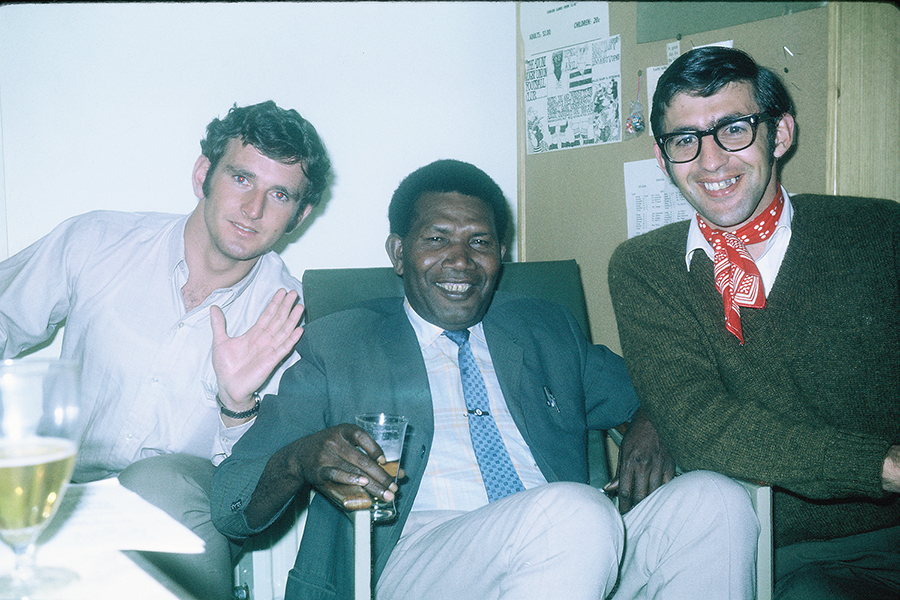
Bill Gammage was a young historian who arrived in Papua New Guinea in the 1960s and became one of the most perceptive observers of the independence generation. As a lecturer at the Administrative College and later the University of Papua New Guinea, he encouraged open debate and documented the emergence of Papua New Guinean leadership. His later writings and oral histories capture both the energy and complexity of those formative years.
Source: Image courtesy of the Pacific Manuscripts Bureau, Australian National University (PMB Photo 46_2337).
Interview with Bill Gammage, conducted by Brad Underhill, 10 September 2025.
Brad Underhill
Okay, I'm going to put this here and hope that they can hear you.
Bill Gammage
I do associate the Bully Beef Club with Six Mile and the Ab College as it was then. Unless something intervened, they used to meet about once a week. I think it was Tuesday mornings.
Brad Underhill
At the college.
Bill Gammage
At the college. And there were people like John Kaputin, Joe Nombri, Bill Warren, and sometimes outside visitors. Albert Maori Kiki, Rapani Watson, okay.
Brad Underhill
Was Somare was there?
Bill Gammage
Not, no, not at this stage. Somare would have been over in Madang, working at Madang until about sixty-eight. My memory relates to sixty-six.
Brad Underhill
Sixty-six, yeah.
Bill Gammage
Ebia [Olewale] was there. I thought he was at the Teacher's College, but I was at the ADCOL, but I stand corrected. I wasn't aware of great activity at the Teacher's College. The atmosphere in the Bully Beef Club was that these are people who were taking administration officials, basically, who were taking the advantage of part way through their careers becoming students, and therefore being able to behave like students. A bit less freer than the university, but nonetheless the presence of the university who were young, not so experienced people, encouraged ADCOL. There was a joint rugby team for example, and they would Bully Beef Club people would swap notes with the university students in the changing rooms and so on. So it was very much the atmosphere of being able to exist with not too much supervision. Occasionally there was a correction and some odd person got reprimanded, but basically it was a sense of freedom rather than any great sense of achievement.
Brad Underhill
And I think you mentioned to me that you came, you went to at least one of the meetings.
Bill Gammage
Yeah, I only went to one at any great length and that was discussing Bob Hawke's decision to be abrasive as a legal tactic during the wage case in 1966. And that was, the discussion was whether or not this was the right approach. Under all those wage cases, there was a sense, one, that they were not going to succeed, and two, that it was unfair. Yeah.
Brad Underhill
And in terms of their impact of the Bully Beef Club members, and obviously a lot of them went on to be leaders, do you think that the culture or the… that the unique characteristics of Papua New Guinean as a nation, what influenced things around the Melanesian way or the eight point plan or the national goals, all those types of things, how do you feel, do you think those discussions were sort of, the origin of them came from?
Bill Gammage
I don't know about origins, but there's a coincidence of time. What you find at that time is that in colonial institutions like the ADCOL, people from all over Papua New Guinea are coming together. People who would not otherwise know each other. Or if they did work for the administration, they'd be working in their home areas and still there'd be that sense of regional, at best, regional comment.
Brad Underhill
Yes.
Bill Gammage
The Bully Beef Club, people came from everywhere. Yes. Same at the university.
Brad Underhill
Yes.
Bill Gammage
And that's what was going to happen. and the build-up to independence. People are going to be recruited in the public service and the army, navy and so on. So in that sense, it was part of the momentum of the times, as it were. And there's very great consciousness of heading towards nation. One great fear was that regionalism would disrupt and still a fear, of course, in some part. So there's a lot of emphasis. Not simply from the senior executives and so on, but from students and Bully Beef Club members themselves. They've got to get this unity idea to work. Boom one time, behave off, unite. Very important.
Brad Underhill
And that came out in the 70s, didn't it, in the debates in the…
Bill Gammage
70s? Yeah, it came out, but I think it was there in '66 in the Bully Beef Club. They were conscious. You know, Joe Nombri was a Highlander.
Brad Underhill
Yeah.
Bill Gammage
First Highlander to get the education that he did.
Brad Underhill
Amazing.
Bill Gammage
Yeah. And then people said, there we are, we've got a Highlander as well as coastal and numbers people.
Brad Underhill
It is quite remarkable when you think that… I was reading in “Sana” Somare's book how Tei Abal was… he was threatened physically, being a Highlander in regard to the… the idea of early independence and all that type of thing, and you look at Nombri, it's pretty amazing.
Bill Gammage
Yeah.
Brad Underhill
The pressure you would have been under, you know.
Bill Gammage
Yeah. Tei was a very astute local leader, a very astute national leader, but he was anxious. That was one of the great potential sources of division, man. The word division was more a touchstone. You talked about something in Highlander's people say, oh, you know, they're not for independence and so on, or Islanders, they're much further along the path of the centre. So any discussion was quite likely to provoke concerns about unity, except that the wage case National wage case brought all Papua New Guineans together. They're all on the same side. It's one of the great advantages of colonialism.
Brad Underhill
There's one bad one, a bad person.
Bill Gammage
Only one bad one, that's right.
Brad Underhill
That's fantastic. Well, I think that'll do all that, if that's okay.
Former Teacher Eric Johns Reflects
Eric Johns was an Australian teacher who worked for many years in Papua New Guinea beginning in the 1960s, mentoring some of the country’s future leaders. Still closely connected with PNG, he encouraged his students to think critically about leadership and responsibility, helping to shape the confidence of a generation preparing for independence.
Interview with Eric Johns, conducted by Brad Underhill, 11 September 2025.
Brad Underhill
Interview with Eric Johns about the Bully Beef Club. So Eric, just give me your characterisation or interpretation of the influence of the Bully Beef Club and the formation or whatever thoughts you've got about the Bully Beef Club.
Eric Johns
Okay, well, no doubt it was a really important thing for PNG. It was a cornerstone of their independence, drive towards independence. But my thought is about the way it was formed in the first place, and that it was not spontaneous. It didn't directly come straight from these PNG students at the administrative college. They were inspired to think like this by their tutors, by the Australian tutors. And that's what started them off in this way. And it's what started off the Bully Beef Club and it continued into the Pangu Parti, which was heavily under the influence of Australians. But as Les Johnson [Education Minister and later Administrator] said at the time, it couldn't have happened any other way. That's the only way it could have happened because they didn't know anything. It's not that they were, you wouldn’t call them ignorant, they just didn't know because they were never told, they were never educated. And if you look back to pre-war, it all goes back to then. In New Guinea, the administration there was always dead set against education for Papua New Guineans. In Papua, [Herbert] Murray would have liked it, but he... He didn't push it either because there was a lot of pushback from Europeans who were against educating Papua New Guineans. And for me, the creation of the Bully Beef Club is all part of this, that Australians led PNG into this, into the Bully Beef Club, into the Pangu Parti. It was Australian led and it had to be that way. There was no other way that it could have been done at that time. And that's generally my thought about it. They were the founding fathers. They simply did not know about it.
Brad Underhill
And these leaders at the time, they were mature men that had had experience working in the administration, many of them hadn't they?
Eric Johns
Yes, and a lot of their thoughts were about discrimination and about discriminatory laws. That's right, the pay disputes and that, yes. Yeah, the pay dispute and the liquor dispute, you know, about the liquor laws and so on, but they had to be led into this idea of seeking independence with PNG and how to do it.
Brad Underhill
So these teachers, they worked for the administration, didn't they? They didn't, they weren't, they were employees of the administration, they weren't like at UNPNG, they were independent, they were employed.
Eric Johns
It was Abel.
Brad Underhill
Yeah, yes, Cecil Abel.
Eric Johns
He was, Ces Abel was one of them. Oh, the guy who was down at Wollongong. What's his name?
Brad Underhill
Oh, yeah, I know who you mean, but yeah, sorry, yeah.
Eric Johns
Sorry, I can't get this. [Barry] Holloway was another one. And they were the people who put these ideas into their head. Samare and Kiki both admitted that, they wrote about it, about how important that was to them, to have those people stimulate their thoughts.
Brad Underhill
And what was the motivation of the teachers to do this?
Eric Johns
I think they were always like this. I think they were anti the way administration was acting and not because they just finished the Hasluck period [1951-63] where he opposed education at a higher level.
Brad Underhill
University education?
Eric Johns
He was dead set against it. And it wasn't until about this time that things started to change. And from pre-war then Hasluck's time and then you come to these new leaders. They just weren't, they never knew what the possibilities were, they were not taught, they were not educated to the level that they could have been educated to, yeah and to say it was not possible was ridiculous when you look back in the 1930s. People like Bishop [Louis] Vangek who in 1930s was became a priest [first Papua New Guinean Roman Catholic bishop] and that was in 1930s, incredible yeah, but that whole pre-war period was a time of total lost time, yeah decades of lost time, yeah and has like didn't make it any better when he came in, well you know it was it was the Bully Beef Club was a great and important thing yeah but you have to remember that it wasn't that spontaneous.